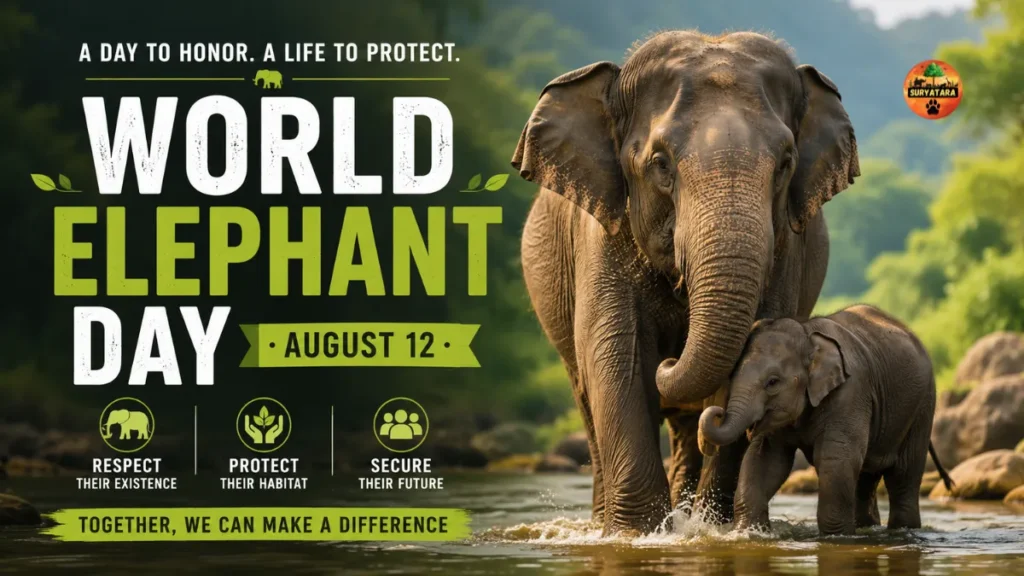
World Elephant Day 2026 is observed every year on August 12 to raise awareness about elephants, the threats they face and the urgent need to protect these magnificent animals. Elephants are among the largest land animals on Earth and play an important role in maintaining healthy forests, grasslands and ecosystems. However, habitat loss, human-wildlife conflict, illegal hunting and other threats continue to put elephant populations under pressure in many parts of the world.
World Elephant Day is not only a day to admire elephants but also an opportunity to understand their importance and think about what can be done to protect them. From Asian elephants in India to African elephants across the African continent, these intelligent and social animals need safe habitats and long-term conservation efforts.
What Is World Elephant Day?
World Elephant Day is an international awareness day dedicated to the protection and conservation of elephants around the world. It is celebrated on August 12 every year and brings attention to the challenges faced by both wild and captive elephants.
The day encourages governments, conservation groups, wildlife experts, communities and ordinary people to support efforts that can improve the future of elephants. It also helps people understand that protecting elephants means protecting the natural environments in which many other species live.
Elephants are not simply large animals that attract tourists and wildlife lovers. They are important ecosystem engineers. Their feeding and movement patterns can change vegetation, create pathways through forests and help spread seeds. Because of this, the health of elephant populations can have a wider impact on the environment.
World Elephant Day History
World Elephant Day was officially launched in 2012 by Canadian filmmakers Patricia Sims and Michael Clark, working with the Elephant Reintroduction Foundation of Thailand. The purpose was to create a global platform for raising awareness about the problems facing elephants and encouraging people to take action for their conservation.
Since then, World Elephant Day has grown into an international awareness campaign. Wildlife organisations, conservationists, schools, zoos, communities and animal lovers use August 12 to share information about elephants and highlight the need for better protection.
The day has become especially important because elephant conservation is not limited to one country. Different elephant populations face different challenges, but many of the major problems are connected to human activities and the loss of natural habitats.
Why Is World Elephant Day Important?
World Elephant Day is important because elephants are facing serious challenges in different parts of their natural range. As human populations grow and land is increasingly used for agriculture, roads, housing and other development, elephants can lose access to the forests and grasslands they need.
When elephant habitats become smaller or fragmented, animals are often forced to move through areas occupied by people. This can lead to crop damage, property loss and dangerous encounters between elephants and local communities.
The situation can become difficult for both sides. Farmers may depend on their crops for their income and food, while elephants need access to their traditional feeding and movement areas. Finding practical ways for people and elephants to share landscapes is therefore a major part of modern conservation.
World Elephant Day helps keep these issues in public attention and encourages people to look beyond the simple image of an elephant as a beautiful wildlife species.
Different Species of Elephants
There are three recognised living elephant species: the African savanna elephant, the African forest elephant and the Asian elephant.
African savanna elephants are generally larger and live in a variety of habitats, including grasslands, woodlands and savannas. African forest elephants are smaller and are adapted to life in the dense forests of Central and West Africa.
The Asian elephant is found in parts of South and Southeast Asia. India has one of the world’s largest populations of wild Asian elephants, making elephant conservation particularly important in the country.
Although all elephants share many characteristics, each species faces its own conservation challenges. Protecting them requires an understanding of their habitat, behaviour, movement patterns and relationship with local communities.
Asian Elephants and Their Importance in India
Asian elephants have a deep connection with India’s forests, culture and history. Wild elephants are found in several parts of the country, particularly in regions with suitable forests and grasslands.
India is home to a significant population of Asian elephants, and the country has several important elephant landscapes. States such as Assam, West Bengal, Karnataka, Kerala, Tamil Nadu and Odisha have important elephant habitats.
Elephants need large areas to find food and water. They also travel long distances between different parts of their habitat. Traditional elephant routes, often known as corridors, are therefore extremely important.
When these corridors are blocked by roads, railways, settlements, farms or other development, elephants can face serious difficulties. Protecting these movement routes is one of the key parts of elephant conservation in India.
The Role of Elephants in Nature
Elephants play a major role in shaping their surroundings. They can knock down vegetation, create openings in dense forests and help other animals access food and water.
One of their most important ecological roles is seed dispersal. Elephants eat fruits and other plant material and can carry seeds over considerable distances before depositing them elsewhere. Some plants benefit greatly from this natural process.
Elephants can also create paths through thick vegetation. These paths may later be used by other animals. In dry areas, their digging behaviour can sometimes help expose water sources that may be used by other wildlife.
Because of these activities, elephants are often described as ecosystem engineers. Their presence can influence the structure and functioning of the landscapes where they live.
Major Threats Faced by Elephants
Elephants face several serious threats, and these problems can vary depending on their location.
Habitat Loss
Habitat loss is one of the biggest challenges for elephants. Forests and grasslands are increasingly affected by agriculture, infrastructure projects, mining, urban growth and other forms of development.
When large natural areas are divided into smaller pieces, elephant herds may find it harder to move safely between feeding and breeding areas.
Human-Elephant Conflict
Human-elephant conflict is another major concern, particularly in areas where farms and elephant habitats overlap.
Elephants may enter agricultural fields while searching for food, sometimes damaging crops. Farmers can suffer financial losses, while elephants may be injured or killed when conflicts become severe.
Conservation programmes increasingly focus on reducing these conflicts through early-warning systems, habitat management, safer corridors and community participation.
Illegal Wildlife Trade and Poaching
Poaching has historically had a devastating impact on elephant populations, particularly because of demand for ivory. Although international restrictions have reduced legal ivory trade, illegal trafficking continues to pose a threat in some areas.
Poaching does more than remove individual elephants. It can affect entire herds and disrupt their social structure, particularly when older and experienced animals are killed.
Climate Change
Climate change can also affect elephants by changing rainfall patterns, water availability and vegetation. Longer periods of drought can make it harder for elephants to find enough food and water.
Changing environmental conditions can also increase pressure on natural resources and make human-wildlife conflict more complicated.
Understanding Elephant Intelligence and Social Behaviour
Elephants are highly social and intelligent animals. They live in family groups and communicate using a combination of sounds, body movements and other signals.
Family groups are often led by experienced females, especially older matriarchs. These elephants can have valuable knowledge about water sources, food locations and safe routes.
Elephants are also known for their strong social relationships. They can show behaviours associated with cooperation, care and responses to the death of other elephants.
Their complex social lives are one reason why elephant conservation must consider more than population numbers. The loss of important members of a herd can have consequences for the group’s behaviour and survival.
Why Elephant Corridors Matter
Elephant corridors are natural or established routes that allow elephants to move between different habitats. These corridors are extremely important because elephants need large landscapes to survive.
A forest area may provide food, while another location may provide water or breeding opportunities. Elephants need to move between these places throughout the year.
If a corridor is blocked, elephants may take alternative routes that pass through villages, farms or roads. This can increase the risk of accidents and conflict.
Protecting and restoring elephant corridors can therefore benefit both wildlife and people. Better land-use planning can help reduce dangerous encounters while allowing elephants to maintain access to important habitats.
World Elephant Day and Elephant Conservation
World Elephant Day gives conservation organisations an opportunity to explain the real challenges faced by elephants. Awareness campaigns can encourage people to learn about responsible wildlife tourism, habitat protection and the dangers of illegal wildlife products.
The day also provides a platform for discussing conservation policies and community-based solutions. Successful elephant conservation cannot depend only on protected forests. It also requires cooperation with people living around elephant habitats.
Local communities are often directly affected by elephant movement. Their experiences and knowledge can be valuable when designing conservation programmes.
How Can We Help Protect Elephants?
There are several ways ordinary people can support elephant conservation.
Learning about elephants is a simple starting point. Understanding why elephants need large habitats and why conflicts occur can help people develop a more balanced view of conservation.
People can also support reputable wildlife conservation organisations and programmes that work on habitat protection, community support and anti-poaching efforts.
Responsible tourism is another important area. Visitors should choose wildlife experiences that respect animal welfare and avoid activities that involve cruelty, exploitation or unsafe interactions with elephants.
People should also avoid buying products made from illegal wildlife materials, including ivory. Reducing demand is an important part of protecting wild animals from illegal trade.
World Elephant Day Activities
World Elephant Day can be observed in many simple and meaningful ways. Schools can organise educational programmes about elephants and their habitats. Wildlife groups can conduct awareness campaigns, talks and conservation events.
Families can use the day to learn about elephant species and watch educational wildlife programmes. Children can read about elephants, draw pictures, prepare presentations or take part in nature-related activities.
Social media can also be used to spread reliable information about elephant conservation. Even a simple message explaining why elephant habitats and corridors matter can help raise awareness.
The most important point is that World Elephant Day should not remain limited to a single day’s celebration. Awareness needs to lead to responsible action throughout the year.
The Future of Elephants
The future of elephants depends on how successfully people can balance development with wildlife conservation. Roads, railways, farms, cities and industries are important for human society, but planning them without considering wildlife movement can create serious problems.
Better protection of forests, restoration of degraded habitats and preservation of elephant corridors can make a major difference. At the same time, communities living near elephant habitats need practical support to reduce crop losses and improve safety.
Conservation also requires long-term research. Scientists and wildlife managers need to understand elephant populations, migration patterns, habitat use and changing environmental conditions.
Technology can support these efforts through tools such as GPS tracking, camera systems and early-warning networks. However, technology alone cannot solve the problem. Strong conservation policies and cooperation with local communities remain essential.
World Elephant Day 2026
World Elephant Day 2026 is another opportunity to focus attention on the importance of elephant conservation. As people around the world observe August 12, the message remains simple: elephants need space, protection and safe natural habitats to survive.
The day also reminds us that conservation is connected to the well-being of people. When forests are protected, water sources are maintained and wildlife corridors remain open, communities and ecosystems can benefit as well.
For countries such as India, where elephants share landscapes with millions of people, finding practical and peaceful ways to reduce human-elephant conflict will remain an important conservation priority.
Frequently Asked Questions About World Elephant Day
When is World Elephant Day celebrated?
World Elephant Day is celebrated every year on August 12. The day focuses on raising awareness about elephants and supporting their conservation.
Why do we celebrate World Elephant Day?
World Elephant Day is celebrated to draw attention to threats such as habitat loss, human-elephant conflict, poaching and illegal wildlife trade. It also encourages people to support elephant conservation.
Who started World Elephant Day?
World Elephant Day was launched in 2012 by Patricia Sims and Michael Clark in collaboration with the Elephant Reintroduction Foundation of Thailand.
How many elephant species are there?
There are three recognised living elephant species: the African savanna elephant, the African forest elephant and the Asian elephant.
Why are elephants important to the environment?
Elephants help shape ecosystems through their feeding and movement. They can disperse seeds, create paths through vegetation and influence the structure of forests and grasslands.
Also read: International Polar Bear Day 2026: A Global Call to Protect the Arctic’s Majestic Predator
What is the biggest threat to elephants?
There is no single threat affecting every elephant population in exactly the same way. Habitat loss, human-elephant conflict, poaching and illegal wildlife trade are among the major challenges.
How can people help elephants?
People can support responsible conservation organisations, avoid illegal wildlife products, choose ethical wildlife tourism and learn about the importance of protecting elephant habitats and corridors.
Also read: World Otter Day 2026: Why These Playful Animals Need Our Protection More Than Ever
Conclusion
World Elephant Day 2026 is much more than an annual celebration of one of the world’s most impressive animals. It is a reminder that elephants need safe habitats, freedom to move and protection from human activities that threaten their survival.
From the forests of India to the grasslands and woodlands of Africa, elephants play an important role in nature. Their survival is closely connected to the health of the ecosystems they inhabit.
Protecting elephants will require long-term conservation, responsible development, community participation and stronger action against illegal wildlife trade. Every August 12, World Elephant Day gives the world a chance to remember that these remarkable animals are part of our shared natural heritage.
The real success of World Elephant Day, however, will not be measured by how many people talk about elephants on one day. It will be measured by the steps taken throughout the year to ensure that future generations can continue to see elephants living safely in the wild.