Digital Innovation Turns Museums into Interactive Cultural Destinations Across Gujarat
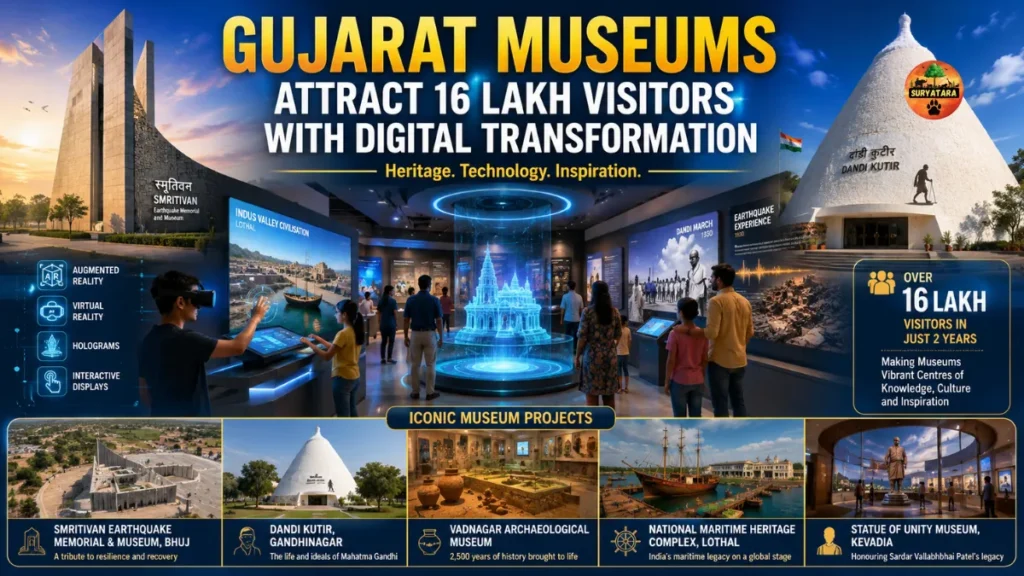
Gujarat Museums are witnessing a remarkable surge in public interest, with more than 16 lakh visitors exploring the state’s cultural institutions over the last two years. The growing footfall reflects a broader transformation taking place across Gujarat Museums, where advanced technology, immersive storytelling, and interactive experiences are reshaping the way people engage with history and heritage.
What were once traditional spaces dedicated to preserving artifacts have evolved into dynamic centers of learning, attracting students, researchers, tourists, and families alike. Through the use of digital tools such as augmented reality (AR), virtual reality (VR), holographic displays, 3D projection mapping, and interactive exhibits, museums across the state are offering visitors a deeper and more engaging understanding of Gujarat’s rich cultural legacy.
Officials say this transformation is part of a larger effort to preserve historical heritage while making it relevant and accessible to modern audiences, particularly younger generations who increasingly seek interactive and technology-driven experiences.
Museums Evolving Beyond Traditional Displays
According to Pankaj Sharma, Director of Archaeology and Museums under Gujarat’s Department of Youth Services and Cultural Activities, museums in the state have undergone a significant shift in recent years.
He noted that modern museums are no longer limited to displaying historical objects behind glass cases. Instead, they have become vibrant educational and cultural spaces where technology helps bring stories, events, and civilizations to life.
The adoption of digital innovations has enabled museums to present historical narratives in ways that are easier to understand and more engaging for visitors. Interactive displays allow guests to participate in learning experiences rather than simply observing exhibits, creating a stronger connection between the audience and the history being presented.
This shift mirrors global trends in museum development, where institutions increasingly use immersive technologies to attract wider audiences and improve educational outcomes.
Gujarat’s Expanding Museum Network
Over the past decade, Gujarat has invested significantly in cultural infrastructure and heritage conservation. As part of these efforts, several new museums have been established across the state, each designed to highlight a unique aspect of Gujarat’s history, culture, and identity.
Among the most notable additions are the Smritivan Earthquake Memorial and Museum in Bhuj, Dandi Kutir in Gandhinagar, and the Vadnagar Archaeological Museum. Together, these institutions represent a new generation of museums that combine historical preservation with cutting-edge presentation methods.
The state government has emphasized the importance of balancing development with heritage conservation. Officials describe this approach as preserving cultural identity while supporting modernization and economic growth.
The philosophy has guided numerous projects aimed at protecting historical sites, promoting cultural awareness, and encouraging tourism linked to heritage destinations.
Smritivan: A Tribute to Resilience and Recovery
One of the most significant examples of this transformation is the Smritivan Earthquake Memorial and Museum in Bhuj.
Built in memory of the thousands of people who lost their lives during the devastating Gujarat earthquake of January 26, 2001, the museum stands as both a memorial and an educational institution. Located on Bhujiyo Hill, the site offers visitors a powerful journey through one of the most challenging chapters in Gujarat’s modern history.
Unlike conventional disaster memorials, Smritivan uses advanced technology to help visitors understand the scale and impact of the earthquake. One of its most talked-about attractions is an earthquake simulation experience that recreates seismic conditions, allowing visitors to gain a deeper understanding of the forces involved during such natural disasters.
The museum goes beyond documenting the tragedy itself. Through immersive exhibits, digital installations, theaters, and multimedia presentations, it tells the story of how communities across Kutch and Gujarat rebuilt their lives after the catastrophe.
Visitors can explore narratives of survival, resilience, and reconstruction, learning how the region transformed itself through collective determination and large-scale rehabilitation efforts.
The museum has emerged as a powerful symbol of human strength, demonstrating how societies can recover and rebuild even after experiencing immense loss.
Dandi Kutir Brings Gandhi’s Legacy to Life
Another landmark among Gujarat Museums is Dandi Kutir in Gandhinagar, a museum dedicated to the life and philosophy of Mahatma Gandhi.
Opened in 2015, Dandi Kutir is notable not only for its content but also for its distinctive architecture. The structure is designed in the shape of a giant mound of salt, symbolizing the historic Salt March led by Gandhi in 1930 as part of India’s struggle for independence.
Inside the museum, visitors are guided through various stages of Gandhi’s life using a combination of modern technologies, including multimedia presentations, synchronized audio-visual effects, animation, projection systems, and interactive displays.
The museum presents Gandhi’s journey from his early years to his role as the leader of India’s freedom movement. Rather than relying solely on traditional exhibits, Dandi Kutir uses storytelling techniques that immerse visitors in important historical events.
Light and sound installations recreate significant moments from Gandhi’s life, while digital presentations explain the social and political movements that shaped India’s path to independence.
Educational institutions frequently organize visits to the museum, making it an important resource for students seeking to understand the values of nonviolence, social reform, and national unity.
By combining technology with historical interpretation, Dandi Kutir demonstrates how museums can inspire reflection and learning while remaining accessible to modern audiences.
Vadnagar Archaeological Museum Showcases 2,500 Years of History
Among the newest additions to Gujarat’s cultural landscape is the Vadnagar Archaeological Museum, which opened in 2025.
The museum was created to preserve and present the rich archaeological heritage of Vadnagar, one of Gujarat’s most historically significant settlements. Excavations in the region have uncovered evidence of multiple cultural phases spanning approximately 2,500 years, making the site an important source of information about ancient civilizations in western India.
What makes the museum unique is its effort to recreate the experience of archaeological exploration. Visitors are not only able to view recovered artifacts but also gain insight into the methods and discoveries associated with excavation work.
The facility incorporates advanced digital tools including augmented reality applications, virtual reality experiences, three-dimensional displays, replicas, and carefully designed dioramas.
These features help explain how the settlement evolved through different historical periods and how archaeologists interpret evidence from the past.
The museum enables visitors to travel through centuries of history, providing context for the artifacts on display and helping audiences understand broader patterns of cultural development.
Experts believe such immersive approaches can significantly improve public understanding of archaeology, a field that is often difficult to communicate through traditional exhibition methods alone.
Technology Reshaping Visitor Experiences
The growing popularity of Gujarat Museums is closely linked to the integration of modern technology into heritage interpretation.
Across the state, museums are increasingly using digital tools to make complex historical subjects easier to understand and more engaging for visitors of all ages.
Augmented reality applications allow users to visualize historical environments and objects in new ways. Virtual reality experiences transport visitors into reconstructed historical settings, helping them experience events and locations that no longer exist in their original form.
Interactive touchscreens provide access to detailed information, photographs, videos, and maps, enabling visitors to explore topics according to their interests.
Holographic displays and projection mapping techniques create immersive visual experiences that can illustrate historical events, cultural traditions, and archaeological discoveries with remarkable clarity.
These technologies are particularly effective in attracting younger audiences, many of whom are accustomed to digital forms of communication and learning.
By embracing innovation, museums are ensuring that heritage remains relevant in an increasingly technology-driven world.
National Maritime Heritage Complex Set to Become Global Attraction
Another major project expected to strengthen Gujarat’s position as a cultural tourism destination is the National Maritime Heritage Complex at Lothal.
Currently under development, the ambitious project is dedicated to showcasing India’s maritime history and the achievements of the ancient Indus Valley Civilization.
Lothal is widely recognized as one of the most important port cities of the Indus Valley Civilization, making it an ideal location for a museum focused on maritime trade and navigation.
Once completed, the complex is expected to become the world’s largest maritime museum.
The project aims to highlight India’s historical connections with international trade networks and demonstrate the important role maritime activities played in shaping economic and cultural exchanges across regions.
Visitors will be able to explore immersive galleries, interactive exhibits, virtual presentations, and detailed models illustrating ancient shipping routes, ports, trade systems, and seafaring technologies.
The complex is also expected to function as a cultural and educational hub, attracting scholars, researchers, students, and tourists from around the world.
Officials believe the project will significantly enhance Gujarat’s reputation as a destination where history, archaeology, and technology come together to create meaningful visitor experiences.
Statue of Unity Museum Continues to Draw Visitors
The museum located within the Statue of Unity complex in Kevadia remains another important component of Gujarat’s heritage tourism network.
Dedicated to the life and contributions of Sardar Vallabhbhai Patel, the museum explores his role in India’s freedom movement and the integration of princely states after Independence.
Through photographs, documents, multimedia displays, and interactive exhibits, visitors gain insight into Patel’s leadership and his lasting impact on the formation of modern India.
The museum complements the larger Statue of Unity attraction, which has become one of the country’s most visited tourist destinations since its inauguration.
Together, the monument and museum provide an educational experience that combines historical interpretation with contemporary presentation methods.
Heritage Conservation and Tourism Growth
The increasing popularity of Gujarat Museums also highlights the growing importance of heritage tourism within the state’s broader tourism strategy.
Cultural tourism has emerged as one of the fastest-growing segments of the travel industry worldwide. Travelers increasingly seek authentic experiences that help them understand the history, traditions, and identity of destinations they visit.
Gujarat’s investment in museums and heritage infrastructure reflects this changing trend.
By improving museum experiences and preserving important historical sites, the state is creating attractions that appeal to both domestic and international visitors.
These efforts also generate economic benefits by supporting local businesses, creating employment opportunities, and encouraging tourism-related development.
At the same time, heritage conservation initiatives help ensure that important cultural resources remain protected for future generations.
Connecting Younger Generations with the Past
One of the primary objectives behind the modernization of Gujarat Museums is to strengthen connections between younger generations and their cultural heritage.
As technology becomes increasingly integrated into daily life, educators and cultural institutions face the challenge of presenting historical subjects in ways that remain engaging and relevant.
Interactive museum experiences provide an effective solution by transforming learning into an active process.
Students can explore historical events through simulations, digital storytelling, virtual reconstructions, and multimedia presentations that make complex topics easier to understand.
Such approaches encourage curiosity, critical thinking, and deeper engagement with history.
Officials believe these efforts play an important role in preserving cultural awareness while fostering a sense of identity and appreciation for the state’s rich heritage.
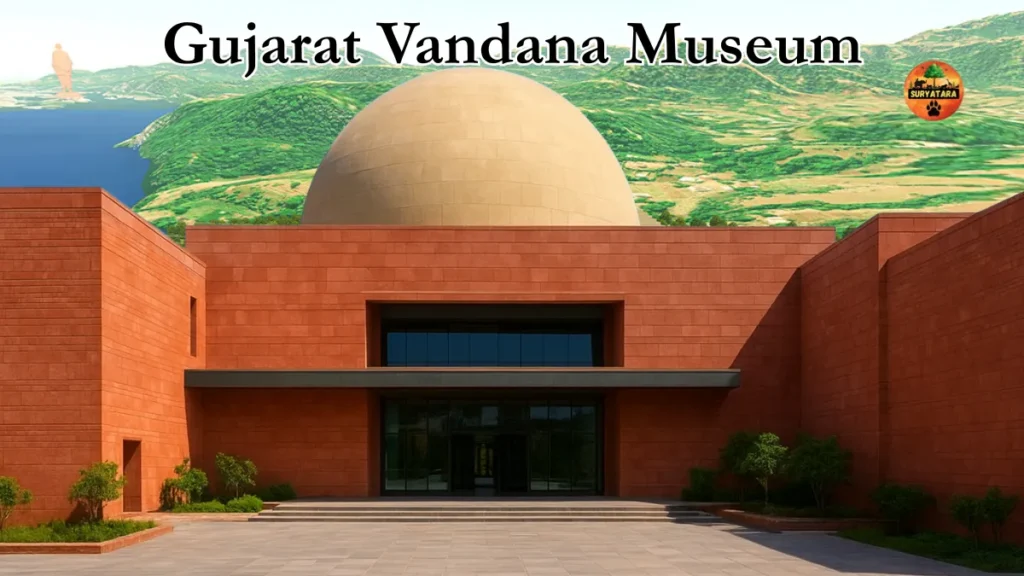
Also read: Gujarat Vandana Museum: A Grand Cultural Landmark Rising Near the Statue of Unity
A New Era for Gujarat Museums
The success of Gujarat Museums over the past two years demonstrates how technology and heritage preservation can work together to create meaningful cultural experiences.
With more than 16 lakh visitors exploring museums across the state, Gujarat has emerged as a leading example of how cultural institutions can evolve to meet contemporary expectations without compromising their educational mission.
From the earthquake memorial at Bhuj and the multimedia storytelling of Dandi Kutir to the archaeological discoveries of Vadnagar and the upcoming maritime heritage complex at Lothal, the state’s museums are offering increasingly diverse and immersive experiences.
As new projects continue to develop and existing institutions expand their digital capabilities, Gujarat’s museum network is expected to play an even greater role in education, tourism, and cultural preservation.
The growing visitor numbers suggest that people are eager to engage with history when it is presented in innovative and accessible ways. By combining cutting-edge technology with centuries of heritage, Gujarat Museums are not only preserving the past but also redefining how future generations experience it.