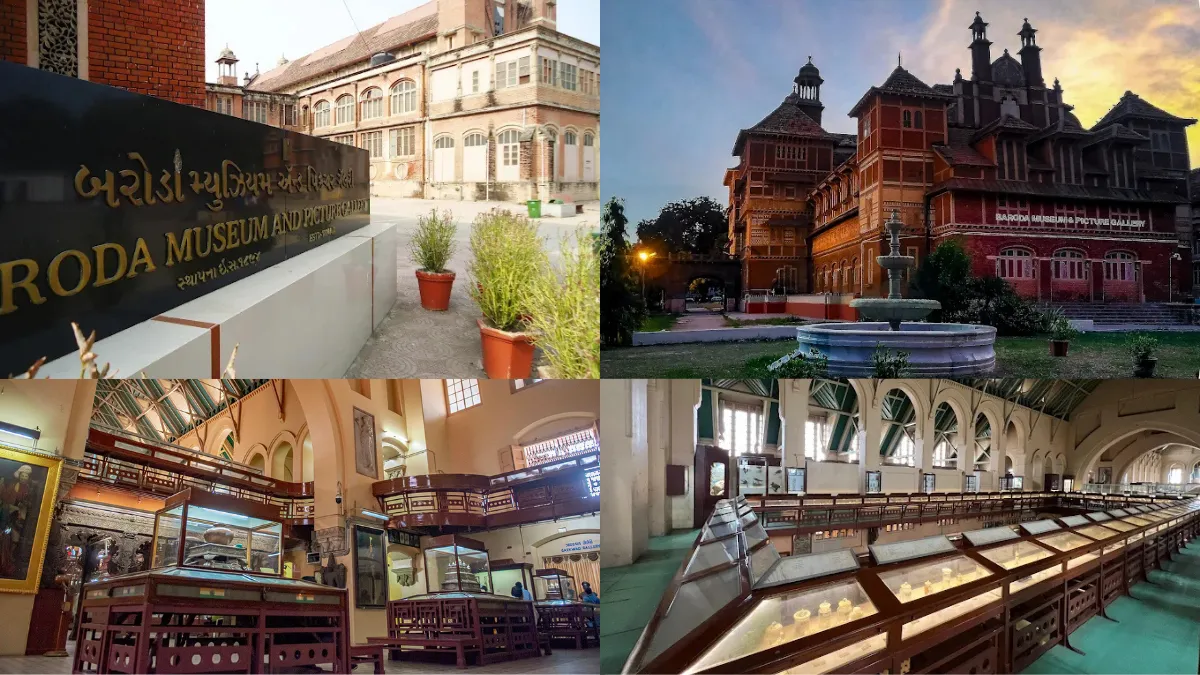
Baroda Museum And Picture Gallery: Vadodara’s cultural landscape continues to attract global attention as tourists, researchers and history enthusiasts flock to the iconic Baroda Museum And Picture Gallery, one of India’s most distinguished heritage institutions. Located inside the sprawling Sayaji Baug—popularly known as Kamati Baug—this landmark remains a centrepiece of Gujarat’s art, culture and scientific history. Built along the banks of the Vishwamitri River, the complex stands on 113 acres and remains one of the largest public parks and educational spaces in the region.
The grand vision for Sayaji Baug was laid out by Maharaja Sayajirao Gaekwad III in 1879. Determined to develop Vadodara into a progressive, knowledge-driven state, the Maharaja commissioned some of the most skilled architects and planners of his era. Among them was the renowned R.F. Chisholm, who designed the museum building in 1894. His mastery is still evident today, as the structure represents a blend of Indo-Saracenic elegance with European architectural influences.
In 1910, the Picture Gallery was added to the complex, introducing Vadodara to a world-class space dedicated to fine arts. Today, it is widely recognised for its impressive collection of original works by celebrated British artists, including J.M.W. Turner and John Constable. These rare paintings attract art scholars from around the world, giving the gallery a distinguished place on the global cultural map.
A Global Magnet for History and Art Lovers
The Baroda Museum And Picture Gallery is especially famous for its diverse range of historical artefacts, many of which are considered priceless. Among its most popular attractions is the Egyptian Mummy—an exhibit that continues to fascinate visitors of all ages. It stands as one of the few authentic mummies displayed in India, providing a rare glimpse into ancient Egyptian civilization.
Another awe-inspiring exhibit is the skeleton of a Blue Whale, displayed with scientific precision. Its sheer size offers visitors a powerful perspective on marine life and natural history. These exhibits contribute significantly to the museum’s reputation as a leading educational destination.
Also notable is the extraordinary collection of Akota bronzes, dating back to the 5th century A.D. These artefacts highlight India’s early craftsmanship in metal casting and religious art. The museum’s collection of Mughal miniature paintings is equally impressive, reflecting the intricate aesthetic traditions of the Mughal courts.
Adding to its diversity, the museum features a dedicated gallery of Tibetan art, offering insight into Himalayan culture through sculptures, ritual objects and paintings. From ethnography to archaeology, the museum houses an expansive selection of pieces that document human history across centuries.
A Cultural Landmark Serving Education and Research
The museum’s role extends far beyond tourism. Scholars, researchers, historians and students often visit Vadodara specifically to study the vast collections preserved inside the museum and gallery. As one of India’s oldest public museums, its contribution to cultural learning has been invaluable.
Several of the displayed paintings are not only original but also globally recognised masterpieces. Art enthusiasts from the UK, US and other international regions frequently highlight the gallery as a must-visit destination due to its rare European works and unparalleled Indian collections. This global appeal helps position Vadodara as an important cultural hub, supporting India’s heritage tourism initiatives.
Accessibility: Vadodara’s Strong Travel Network
Reaching the Baroda Museum And Picture Gallery is convenient for both domestic and international visitors due to the city’s well-connected transport system.
By Road:
Vadodara is easily accessible via National Highway 8 (NH-8), which serves as a major route connecting Delhi, Ahmedabad, Mumbai and other major cities. The city’s efficient road network makes Sayaji Baug convenient to reach from any part of Vadodara.
By Train:
Situated on the high-traffic Mumbai-Delhi Western Railway Mainline, Vadodara Junction is one of India’s busiest rail stations. Premium trains such as the Rajdhani and Shatabdi operate through this route, enabling smooth and quick travel for tourists across the country.
By Air:
Vadodara Airport (BDQ) offers domestic flight connectivity to major Indian cities, including Delhi, Mumbai, Bengaluru and Hyderabad. International travelers typically arrive through connecting airports, making the museum a reachable destination for visitors from the UK, US and other global locations.
A Must-Visit Destination for Global Travelers
Today, the Baroda Museum And Picture Gallery stands as a vibrant blend of art, history, culture and science. Its extensive collections, architectural beauty and educational value make it one of India’s top cultural institutions. Whether it is the Blue Whale skeleton, the Egyptian mummy, Turner’s landscapes or ancient bronzes, each gallery tells a story that resonates with visitors across continents.
With its strategic location, rich heritage and global appeal, the museum continues to strengthen Vadodara’s presence on the world tourism map. As interest grows among travelers and scholars—especially from the UK and US—the destination is poised to shape future cultural conversations and preserve India’s artistic legacy for generations to come.