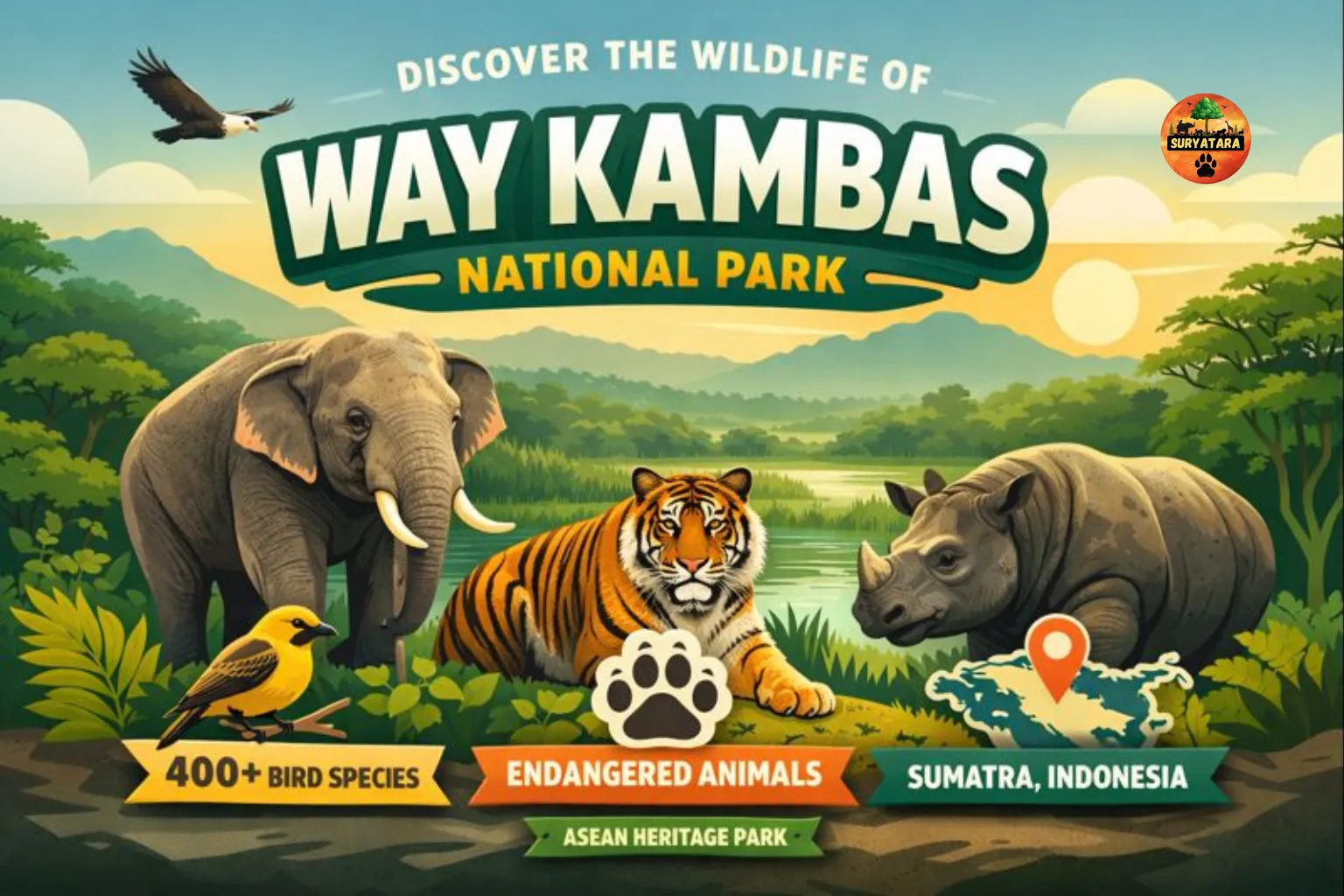
Lampung, Indonesia — Nestled in the southern reaches of Sumatra, Way Kambas National Park stands as one of Southeast Asia’s most significant strongholds for endangered wildlife. Widely recognised as the last refuge for the iconic Sumatran elephant, the park is far more than an elephant conservation site. It is a vast and complex ecosystem that supports hundreds of bird species, dozens of rare mammals, and some of the most threatened animals on Earth, including the elusive Sumatran tiger and Sumatran rhinoceros.
Covering more than 125,600 hectares of swamp forest and lowland rainforest, Way Kambas National Park represents a crucial component of Indonesia’s natural heritage. Its international importance was further reinforced this year when the park was officially designated as an ASEAN Heritage Park, a title reserved for areas with exceptional biodiversity, ecological value, and cultural significance.
Yet behind this recognition lies a sobering reality. Decades of habitat degradation, illegal activities, and increasing pressure from surrounding human settlements continue to threaten the park’s fragile ecosystems. Conservationists warn that protecting Way Kambas National Park will require sustained commitment, strong law enforcement, and close cooperation between local communities, government agencies, and international conservation organisations.
A Biodiversity Hotspot in Southern Sumatra
Located in Lampung Province, Way Kambas National Park is one of Indonesia’s oldest protected areas. While it is often associated with elephant conservation, the park’s biological richness extends far beyond a single species.
Surveys conducted over the years have recorded more than 406 species of birds within the park, making it one of the most important bird habitats in Sumatra. These include migratory species, endemic forest birds, and wetland specialists that depend on the park’s mosaic of swamps, grasslands, and forest corridors.
In addition to its avian diversity, Way Kambas National Park is home to at least 50 mammal species, many of which are classified as endangered or critically endangered on the global conservation scale. Among them are:
- The Sumatran elephant, whose population has declined dramatically across the island
- The Sumatran tiger, one of the rarest big cats in the world
- The Sumatran rhinoceros, teetering on the edge of extinction
These species rely on intact forest cover, access to water sources, and undisturbed migration routes — all of which have been increasingly compromised over the past several decades.
Legacy of Habitat Degradation
The challenges facing Way Kambas National Park did not emerge overnight. Much of the damage to its ecosystems can be traced back to the 1960s and 1970s, when extensive logging operations stripped large areas of lowland forest across Sumatra.
During that period, weak environmental regulations and limited enforcement allowed widespread timber extraction, even in areas that would later be recognised as ecologically critical. As forest cover declined, wildlife populations were forced into smaller, fragmented habitats, leading to reduced genetic diversity and increased vulnerability to human interference.
The long-term consequences of this degradation are still visible today. While the park remains one of the most important conservation landscapes in Indonesia, parts of its ecosystem have yet to fully recover. This has left wildlife populations more exposed to modern threats such as poaching, illegal land clearing, and conflict with nearby communities.
ASEAN Heritage Park Status: Recognition and Responsibility
The recent designation of Way Kambas National Park as an ASEAN Heritage Park marks a major milestone for conservation in Indonesia. The title recognises areas of outstanding natural value that are considered irreplaceable on a regional and global scale.
However, the designation also comes with heightened expectations. To maintain its ASEAN Heritage status, the management of Way Kambas National Park must demonstrate measurable progress in protecting biodiversity, restoring degraded habitats, and addressing threats to wildlife populations.
Conservation experts stress that international recognition alone is not enough. Without effective on-the-ground action, protected status risks becoming symbolic rather than transformative.
Mounting Conservation Challenges
Despite its protected status, Way Kambas National Park continues to face a range of serious conservation threats.
Illegal Logging and Deforestation
Although large-scale commercial logging has declined, illegal logging remains a persistent problem. Small-scale timber extraction, often driven by economic necessity, gradually erodes forest cover and disrupts wildlife habitats.
Current estimates indicate that Way Kambas National Park experiences deforestation at an average rate of 0.109% per year. While this figure may appear modest, even small losses can have outsized impacts on species that require large, continuous territories, particularly elephants and tigers.
Habitat loss caused by illegal logging often pushes wildlife closer to the park’s boundaries, increasing the likelihood of encounters with human settlements.
Human–Elephant Conflict
One of the most visible consequences of habitat degradation is human–elephant conflict. As forest resources shrink, elephants are more likely to venture into nearby villages in search of food, damaging crops and property in the process.
Although such encounters do not always result in direct harm to elephants, they can have severe social consequences. Communities affected by crop losses may develop resentment toward conservation efforts, weakening public support for wildlife protection.
Conservationists emphasise that addressing human–elephant conflict is as much a social challenge as an ecological one. Long-term solutions require building trust with local residents and ensuring that conservation efforts also benefit human livelihoods.
Poaching and Wildlife Crime
Illegal wildlife trade remains another major concern in Way Kambas National Park. Elephants are particularly vulnerable due to the high value of ivory on the black market.
Illegal poaching not only reduces wildlife populations but also undermines law enforcement efforts and fuels organised wildlife crime networks. In some cases, habitat encroachment and logging activity create access routes that poachers exploit to reach deeper areas of the park.
Forest Fires
Seasonal forest fires, often exacerbated by dry conditions and land-clearing practices outside the park, pose additional risks. Fires can destroy large swathes of vegetation, displace wildlife, and degrade soil quality, making habitat recovery even more difficult.
Conservation in Action: Collaborative Approaches
Despite these challenges, Way Kambas National Park has become a model for collaborative conservation, particularly through long-standing partnerships between government agencies and international organisations.
One of the most influential contributors has been Wildlife Conservation Society – Indonesia Program (WCS-IP), which has supported conservation efforts in the park since 2000.
Wildlife Response Unit: Reducing Conflict on the Ground
At the heart of WCS-IP’s work in Way Kambas National Park is the Wildlife Response Unit (WRU). This specialised team focuses on mitigating human–elephant conflict and preventing situations that could escalate into harm for both people and wildlife.
The WRU operates across villages surrounding the park, monitoring 163 known elephant movement routes that intersect with human settlements. By tracking elephant behaviour and responding rapidly to conflict reports, the team helps reduce crop damage and prevent retaliatory actions against elephants.
Key components of the WRU programme include:
- Conflict response and early warning systems
- Community-based mitigation training
- Establishment of village forums that enable local residents to manage conflicts independently
This approach empowers communities to take an active role in conservation, reducing reliance on external intervention and fostering a sense of shared responsibility.
Strengthening Law Enforcement Through SMART Patrols
To combat illegal activities within Way Kambas National Park, WCS-IP has also supported the establishment of two dedicated SMART patrol units. SMART (Spatial Monitoring and Reporting Tool) patrols use data-driven methods to track illegal logging, poaching, and other threats across the park.
These patrols are specifically tasked with targeting illegal killing of elephants and other wildlife crimes. By systematically collecting and analysing field data, park authorities can deploy resources more effectively and identify high-risk areas before incidents escalate.
Using Science to Protect Elephants
Scientific research has played a crucial role in guiding conservation strategies in Way Kambas National Park. One of the most significant initiatives involved studying elephant populations through DNA analysis of elephant faeces.
Conducted in 2010, this non-invasive research method allowed scientists to estimate population size, genetic diversity, and movement patterns without disturbing the animals. The findings revealed that the elephant population in Way Kambas National Park remained stable between 2002 and 2010, offering a rare note of optimism amid broader regional declines.
DNA evidence has also been used in wildlife crime investigations, strengthening legal cases against poachers. In collaboration with the Eijkman Institute, genetic analysis has helped link confiscated ivory and other wildlife products directly to crime scenes, improving prosecution outcomes.
The Role of Communities in Conservation
Experts agree that the future of Way Kambas National Park depends heavily on the support of surrounding communities. Conservation programmes that fail to consider local needs often struggle to achieve lasting success.
By investing in training, dialogue, and community-led initiatives, conservation organisations aim to shift perceptions of wildlife from threats to shared natural assets. Village forums established around the park now play a key role in coordinating conflict mitigation, sharing information, and fostering cooperation between residents and park authorities.
Read also: Gir National Park and Wildlife Sanctuary: India’s Legendary Home of the Asiatic Lion
Looking Ahead: Protecting a Global Treasure
As pressure on natural landscapes intensifies across Southeast Asia, Way Kambas National Park stands at a crossroads. Its designation as an ASEAN Heritage Park highlights its global importance, but also underscores the urgency of protecting what remains.
Sustaining conservation gains will require:
- Continued investment in law enforcement and monitoring
- Strong partnerships between government, NGOs, and research institutions
- Long-term engagement with local communities
- Ongoing scientific research to guide adaptive management
For Indonesia, the stakes are high. The survival of the Sumatran elephant, tiger, and rhinoceros depends not only on protected areas like Way Kambas National Park, but on the effectiveness of the strategies used to safeguard them.
Read also: Kanha National Park Ticket Price: A Detailed Breakdown for First-Time Visitors
A Symbol of Hope and Responsibility
Way Kambas National Park is more than a wildlife sanctuary. It is a symbol of both the damage humans can inflict on nature and the potential for recovery through collective action.
While challenges remain, decades of conservation work have demonstrated that progress is possible when science, community engagement, and strong governance come together. As global attention increasingly turns toward biodiversity loss and climate resilience, Way Kambas National Park offers valuable lessons for conservation efforts worldwide.
Protecting this irreplaceable landscape is not just an Indonesian responsibility — it is a global one.