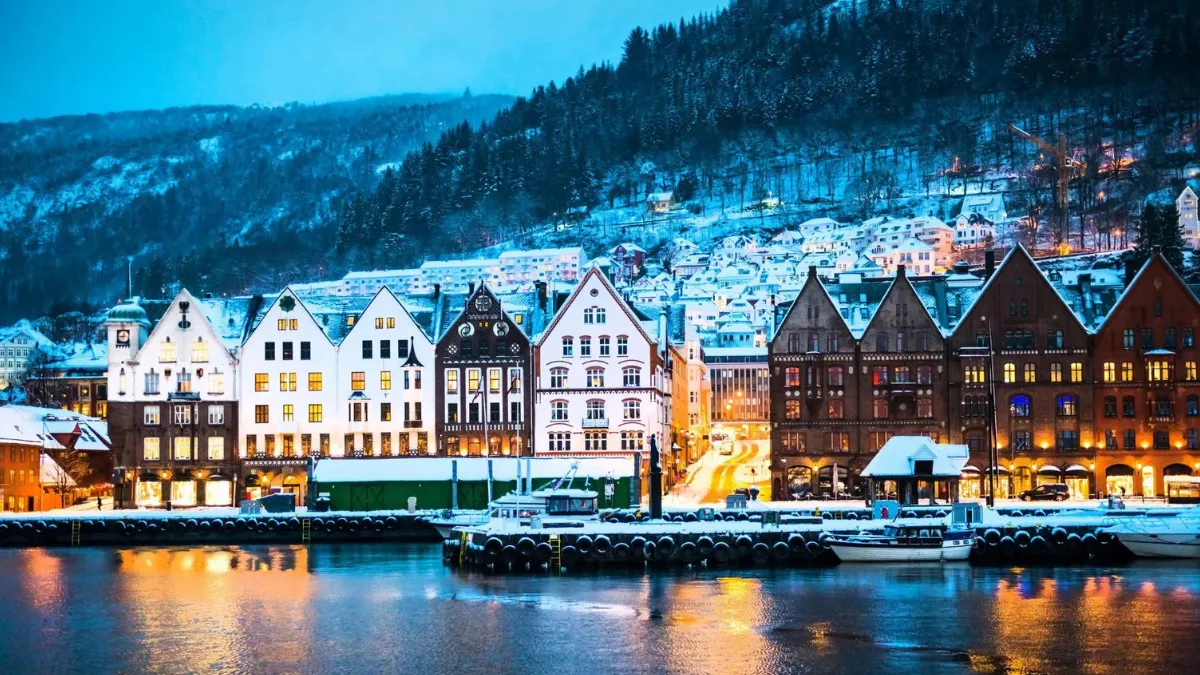
Bergen, Norway — The legendary waterfront district Bryggen, a UNESCO World Heritage treasure, is gaining global attention as one of the world’s best-preserved medieval trading ports. The historic site, situated on the western coast of Bergen, stands today not only as a major cultural symbol of Norway but also as a rare surviving testament to Europe’s once-dominant Hanseatic League.
Dating back to the 12th century, Bryggen rapidly evolved into a centre of international commerce. By 1350, the Hanseatic League — a vast trading empire that once controlled maritime trade across Northern Europe — firmly established its office in Bergen, gaining exclusive rights for stockfish trade from Northern Norway. Among the four overseas Hanseatic trading offices of that era, Bryggen is the only one preserved in the world today, making it an unparalleled monument to global trading history.
A City Reborn Again and Again: The Resilience of Bryggen
Despite its historical prestige, Bryggen’s journey has been turbulent. Over centuries, devastating fires — the most recent in 1955 — repeatedly destroyed its wooden structures. Yet each time, the waterfront was rebuilt meticulously using original layouts and timber construction traditions. This dedication to authenticity ensured that the medieval footprint of Bryggen survived almost unchanged.
The district’s architectural identity, mostly shaped after the massive fire of 1702, still features:
- Narrow wooden alleyways
- Rows of 2–3 storey timber buildings
- Gabled façades facing the harbour
- Storage cellars built of fireproof stone
- Compact medieval urban layout
Today, around 62 original buildings remain, containing everything necessary to understand how German merchants lived and conducted business — with offices and living quarters in the front, warehouses at the centre, and communal halls, kitchens, and fireproof cellars at the back.
Urban historians describe Bryggen as one of the finest existing representations of a northern “fondaco” — a marketplace and living colony established by foreign merchants inside a host country. Globally, no similar medieval trade settlement survives in such complete form.
Cultural and Social Significance: A True Colony That Outlived the Hanseatic Era
Even after the Hanseatic merchants departed, their identity echoed through life in Bryggen. The German trading community retained control of the post until 1754, when Norwegian merchants and shipowners — many of German descent — established a local trading post.
Bryggen continued to operate as a powerful economic centre well into the modern era. But by the 1900s, traditional trade declined, leaving many buildings abandoned. The tide turned in the 1960s, when large-scale preservation efforts began, eventually leading to Bryggen’s inscription on the UNESCO World Heritage List in 1979.
Today, Bryggen reflects a blend of history and modern cultural life:
- Craft workshops and artisan studios
- Museums and cultural centres
- Restaurants and tourism businesses
- Heritage-based educational programs
While these additions bring foot traffic and economic vibrancy, efforts continue to strike a balance between tourism and conservation.
Integrity and Authenticity — Why Bryggen is Irreplaceable
Even though only one-fourth of the original medieval structures remain, the historical core, building techniques and urban layout have survived. Researchers, architects, and conservationists confirm that Bryggen still reflects the social and professional life of merchants of the Middle Ages.
Key preservation factors include:
Limited use of replacement materials
Restoration using original timber methods and tools
Documentation of all structural interventions
Protection of archaeological deposits below ground
Fire-detection and suppression systems across the district
Since 2000, the restoration focus has shifted to preserving original architectural elements — right down to authentic materials such as paint formulas, timber selection, nails, and wooden plugs.
Despite commercial modernisation along the main façade, the deeper interior passages still preserve the quiet atmosphere of the Hanseatic era, offering visitors a rare opportunity to experience medieval Europe without reconstruction or simulation.
Present-Day Challenges: Climate, Tourism and Urban Pressure
Experts warn that Bryggen faces serious risks that must be tackled collectively:
Fire hazards from dense wooden architecture
Growing tourist numbers and structural stress
Climate change leading to rising sea levels and harsher weather
Pressure for new urban development nearby
Authorities continuously monitor environmental and visual impact to prevent disruption of the heritage skyline.
Also read: Boston Common Park: Exploring the Heart and History of America’s Oldest Urban Green Space
Management and Long-Term Protection of Bryggen
Bryggen is legally safeguarded under the Norwegian Cultural Heritage Act and the Norwegian Planning and Building Act. Protection policies include a broad conservation zone extending beyond the immediate area.
Ownership is shared, but most buildings fall under the Bryggen Foundation, established in 1962 specifically for preservation. Property owners, heritage authorities, and experts collaborate through multiple advisory groups to ensure every intervention is scientifically justified.
A dedicated program — The Bryggen Project, launched in 2000 — oversees:
- Restoration of wooden buildings
- Preservation of archaeological layers
- Visitor and tourism management
- Environmental risk mitigation
Regular policy reviews ensure the site remains prepared for the next century of conservation.
Also read: Statue of Liberty: Exploring the Legacy Behind the World’s Most Famous Statue
Why Bryggen Matters to the World — And Why It Must Be Protected
Bryggen is more than a tourist destination. It is:
A rare architectural survivor of medieval northern Europe
A living record of international maritime trade
A preserved archaeological archive beneath its foundations
A window into the engineering skills, lifestyles, economy and social structures of the Hanseatic era
For historians, architects and travellers from around the world, Bryggen is one of the clearest real-world connections to Europe’s commercial past — a reminder of how trade and cultural exchange shaped modern society.
Also read: Northern Lights Safari: An Unforgettable Journey Into the Arctic Sky
Conclusion
As global travel rebounds, Bryggen is ready to welcome the world again — but with a mission to secure its future. The site proves that authenticity, resilience and knowledge can help humanity preserve its heritage without compromising the identity of the past.
The old timber walls of Bryggen have witnessed war, wealth, decline, and revival — and today they stand stronger than ever, reminding the world of a pivotal era in global history.