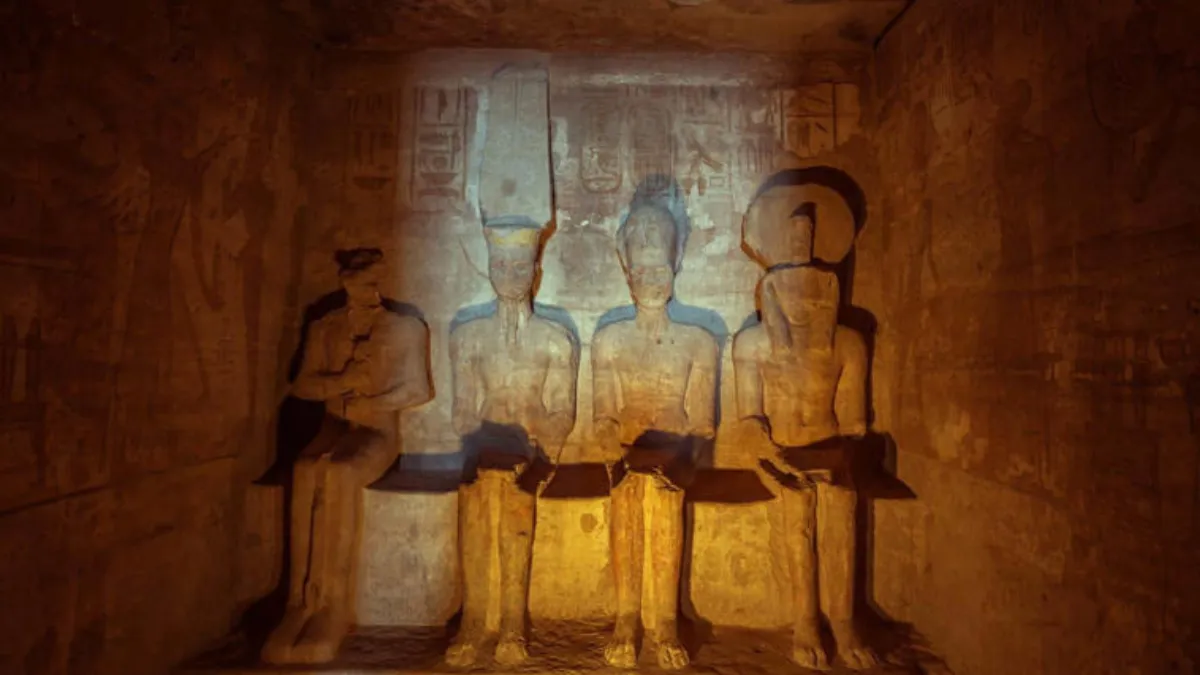
Twice each year, just after dawn breaks over southern Egypt, a narrow shaft of sunlight travels through solid rock and ignites a 3,000-year-old mystery. For a few breathless minutes inside the Great Temple of Ramses II, three colossal statues glow in golden light while a fourth remains in darkness. The crowd falls silent. Cameras lower. History feels alive.
The Abu Simbel sun festival is not just a tourist attraction. It is a working demonstration of ancient astronomical engineering — a solar alignment designed in the 13th century BCE that still functions today.
What unfolds inside the temple is more than spectacle. It is evidence of scientific precision, religious symbolism and architectural mastery from one of ancient Egypt’s most powerful rulers. And in the modern era, it has become a global cultural event drawing visitors, researchers and media attention from across the UK, the US and beyond.
Where It Happens: Abu Simbel
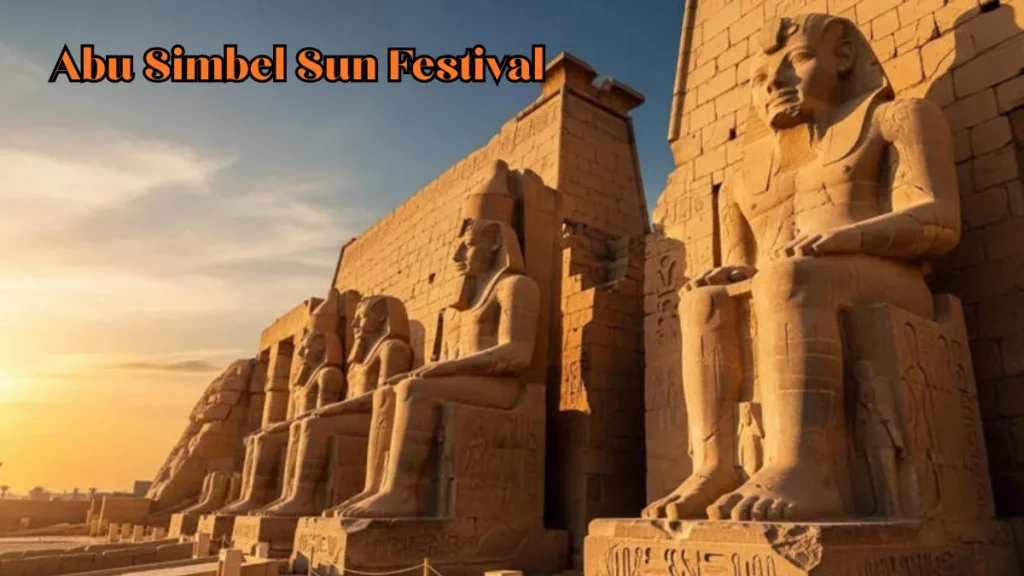
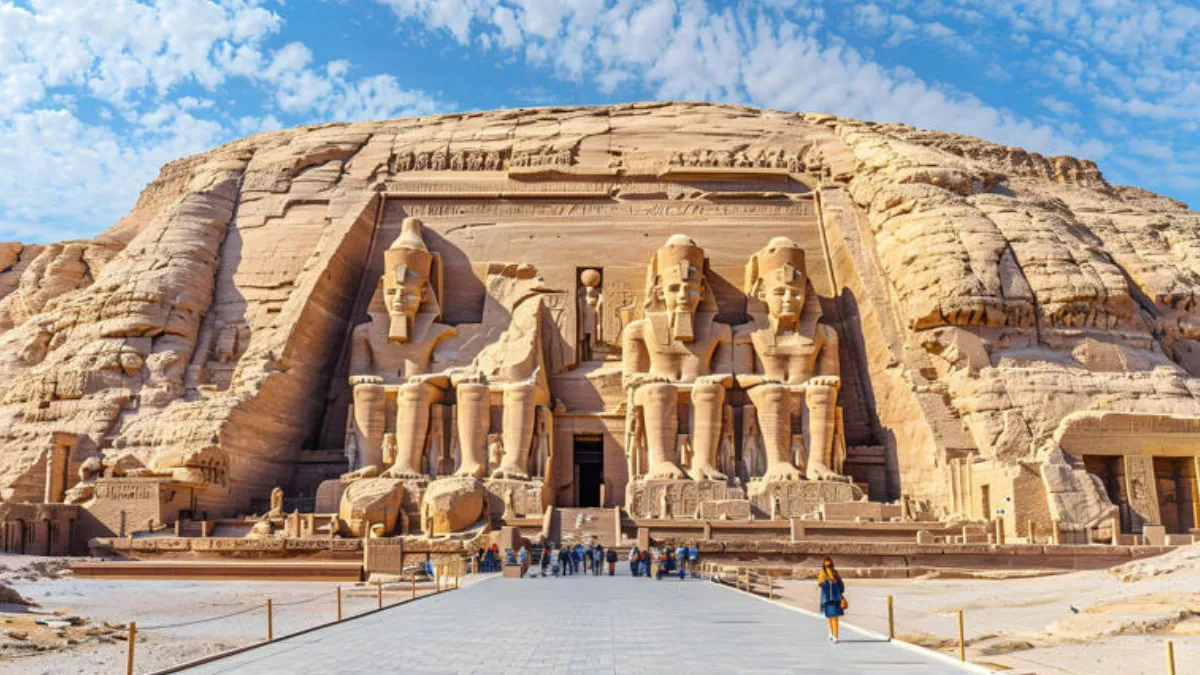
Located in southern Egypt near the Sudanese border, Abu Simbel sits beside the vast waters of Lake Nasser. The site is home to two rock-cut temples commissioned by Ramses II, one of the most celebrated rulers of the New Kingdom period.
The larger of the two, known as the Great Temple, is the stage for the Abu Simbel sun festival. Carved directly into a sandstone cliff, the temple was built not only as a monument to royal power but as a statement of divine legitimacy.
And twice a year, that statement is illuminated by the rising sun itself.
What the Abu Simbel Sun Festival Actually Is
At its core, the Abu Simbel sun festival revolves around a remarkable solar alignment.
On or around February 22 and October 22, the rising sun aligns perfectly with the temple’s central axis. The sunlight enters through the main entrance, travels roughly 60 meters (about 200 feet) down a long stone corridor, and reaches the innermost sanctuary.
There, four seated statues await.
Three of them — Ramses II, the sun god Ra-Horakhty, and the god Amun — are bathed in brilliant golden light. The fourth statue, representing Ptah, remains in shadow.
The effect lasts only about 15 to 20 minutes.
But those minutes are the reason thousands of visitors wake in the middle of the night and travel across the desert to witness it.
Egypt’s tourism authorities now promote the Abu Simbel sun festival as both a scientific wonder and a cultural celebration. International journalists cover it. Travel influencers flock to it. Yet at its heart, it remains a 3,000-year-old astronomical event unfolding exactly as designed.
Why Those Dates Matter — And Why Scholars Debate Them
Many tour operators explain that the February and October alignments mark Ramses II’s birthday and coronation day. It is an appealing story: a pharaoh arranging for the sun to honor him twice each year.
However, Egyptologists caution that the reality is more complex.
Ancient Egyptian calendars differed from modern systems, and the exact birth and coronation dates of Ramses II are still debated. There is no unanimous academic agreement that February 22 and October 22 were chosen specifically to celebrate those events.
Adding another layer of intrigue is the relocation of the temples in the 1960s.
Before the temples were moved to protect them from flooding, some specialists believe the alignment occurred on February 21 and October 21. After reconstruction, the alignment appears to fall on the 22nd.
This suggests that while the modern Abu Simbel sun festival closely mirrors the ancient phenomenon, it may not replicate it with absolute precision. Even so, the difference of a single day over millennia is widely regarded as an extraordinary achievement.
How the Solar Alignment Works
No mirrors. No hidden lenses. No modern tricks.
The Abu Simbel sun festival is the result of geometry, orientation and careful planning.
When Ramses II commissioned the temple in the 13th century BCE, architects aligned the entrance and central corridor with the rising sun’s path at specific points in the solar calendar. Because the sun’s position on the horizon shifts gradually throughout the year, its rays line up almost perfectly with the temple’s axis only on those two mornings.
The beam travels in a straight path to the sanctuary.
And then comes the most symbolic detail: three statues illuminate, one remains in shadow.
Ptah, the god associated with darkness and the underworld, was intentionally positioned so that the sunlight would not reach him. Whether this symbolism was religious, political or both, specialists agree the alignment was deliberate and demonstrates advanced astronomical knowledge in New Kingdom Egypt.
The Abu Simbel sun festival, therefore, is ancient science still in action.
Saved From the Waters: UNESCO’s Historic Rescue
In the 1960s, the future of Abu Simbel looked uncertain.
The construction of the Aswan High Dam threatened to submerge the temples beneath the rising waters of Lake Nasser. Without intervention, one of the world’s greatest archaeological sites would have disappeared forever.
An international campaign led by UNESCO launched a historic rescue mission. Engineers cut the temples into massive blocks, moved them to higher ground and carefully reassembled them.
The operation preserved not only the temples themselves but also the crucial solar alignment that defines the Abu Simbel sun festival.
Today, Abu Simbel is part of the UNESCO World Heritage listing known as the Nubian Monuments from Abu Simbel to Philae. The rescue effort has become a powerful symbol of global cooperation to protect cultural heritage.
Visitors attending the sun festival are witnessing not just ancient brilliance, but also modern preservation triumph.
What It’s Like to Attend the Abu Simbel Sun Festival
For many travelers, the experience begins long before sunrise.
Most visitors depart from Aswan around 2:00 or 3:00 a.m., making the three-hour desert journey under a dark sky. The atmosphere on festival mornings feels electric — part pilgrimage, part celebration.
By the time the temple opens, the forecourt is buzzing.
Groups wrap themselves in jackets against the early chill. Guides organize their parties. Cameras are checked and rechecked. Nubian musicians prepare outside, their drums and instruments hinting at the festivities to come.
Inside the temple, visitors line the central corridor. The anticipation builds.
Then it happens.
A thin beam of light appears at the entrance. Slowly, steadily, it advances down the passage. When it finally reaches the sanctuary and illuminates the statues, the room falls into near silence.
For roughly 15 to 20 minutes, ancient stone glows as if newly carved.
Then the angle shifts. The light fades. And the moment is over.
Beyond the Beam: The Festival Atmosphere
Once the illumination ends, the celebration moves outdoors.
Local cultural groups perform traditional Nubian music and dance. Markets spring to life, selling crafts, bread, tea and souvenirs. The Abu Simbel sun festival becomes not only an astronomical event but a showcase of southern Egypt’s living heritage.
This blending of ancient and modern gives the day its unique character.
You may start your morning watching sunlight strike a pharaoh’s statue inside a rock-cut sanctuary. By late morning, you could be sipping tea while drums echo against the cliff face.
For many visitors, that contrast — 3,000 years of history meeting present-day community pride — is what makes the festival unforgettable.
Is the Abu Simbel Sun Festival Worth It?
The answer depends on what kind of traveler you are.
Festival mornings are crowded. Tour buses line up. Interior space is limited. The drive from Aswan is long, and temperatures can shift quickly from cold before dawn to intense heat later in the day.
It is not a polished theme-park production.
But for those passionate about ancient Egypt, astronomy or extraordinary travel experiences, the Abu Simbel sun festival often feels like a once-in-a-lifetime moment.
If you prefer quieter experiences, visiting Abu Simbel on a non-festival day offers a calmer atmosphere while still allowing you to appreciate the temple’s grandeur.
Yet even outside festival dates, knowing the solar alignment exists adds depth to every step inside.
A Brief Beam With a Long Story
In practical terms, the Abu Simbel sun festival lasts less than half an hour.
In historical terms, it spans millennia.
That narrow beam of light connects New Kingdom architects with modern engineers, ancient priests with contemporary tourists, royal symbolism with scientific precision.
Debates over exact dates and symbolism do not diminish the experience — they enrich it. Understanding that scholars continue to examine the alignment only deepens appreciation for the sophistication of its design.
The festival becomes less about capturing the perfect photograph and more about witnessing how knowledge, belief and architecture can converge in a single, fleeting moment.
And perhaps that is why the Abu Simbel sun festival continues to captivate global audiences: it is a reminder that ancient civilizations were not mysterious relics, but masters of science, mathematics and imagination.
Travel Safety After Sunset: A Different Side of Paradise
While events like the Abu Simbel sun festival celebrate the brilliance of ancient culture, modern travel presents its own realities.
Many tropical destinations appear idyllic by day — postcard beaches, swaying palms and vibrant markets. But once the sun sets, some locations experience sharp changes in atmosphere.
Recent safety data and traveler reports suggest that certain high-profile holiday spots can become more volatile after dark. Increased petty crime, nightlife-related incidents and reduced visibility can contribute to safety concerns.
For travelers, the lesson is simple: research thoroughly, remain aware of surroundings and respect local guidance.
Dream destinations deserve enthusiasm — but also informed caution.
The Enduring Power of the Abu Simbel Sun Festival
In an age of digital light shows and carefully staged spectacles, the Abu Simbel sun festival stands apart.
It is not powered by electricity. It does not rely on scripts or stage effects.
It depends solely on the Earth’s orbit, the angle of the sun and the precision of architects who lived three thousand years ago.
Each February and October, when dawn breaks over Lake Nasser and that shaft of light reaches the sanctuary, the world witnesses a rare continuity between ancient science and modern curiosity.
The beam lasts only minutes.
The story behind it lasts forever.
And that is why the Abu Simbel sun festival remains one of the most extraordinary cultural and astronomical events on Earth — a fleeting moment that carries the weight of history across centuries and continues to shine for generations to come.