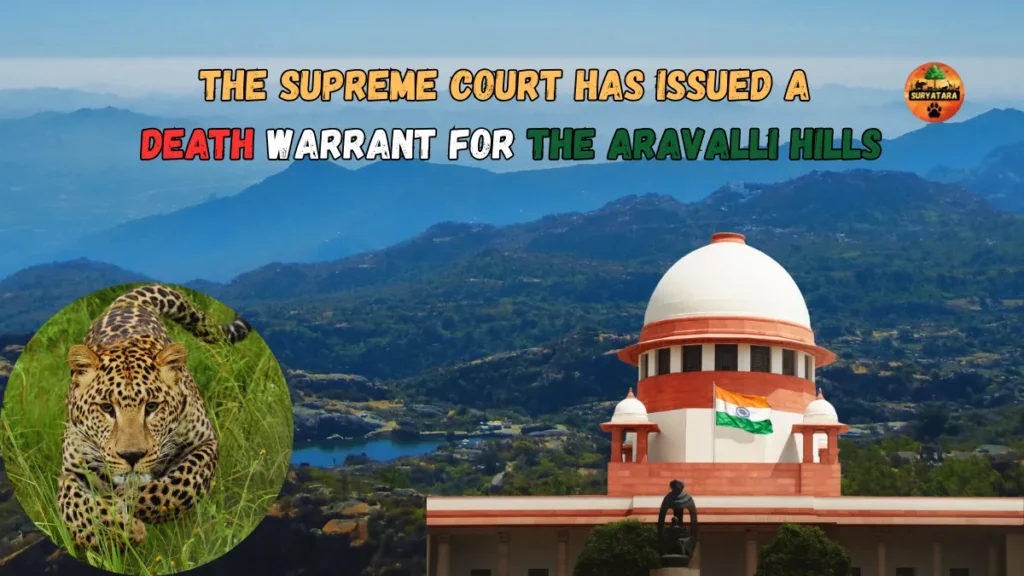
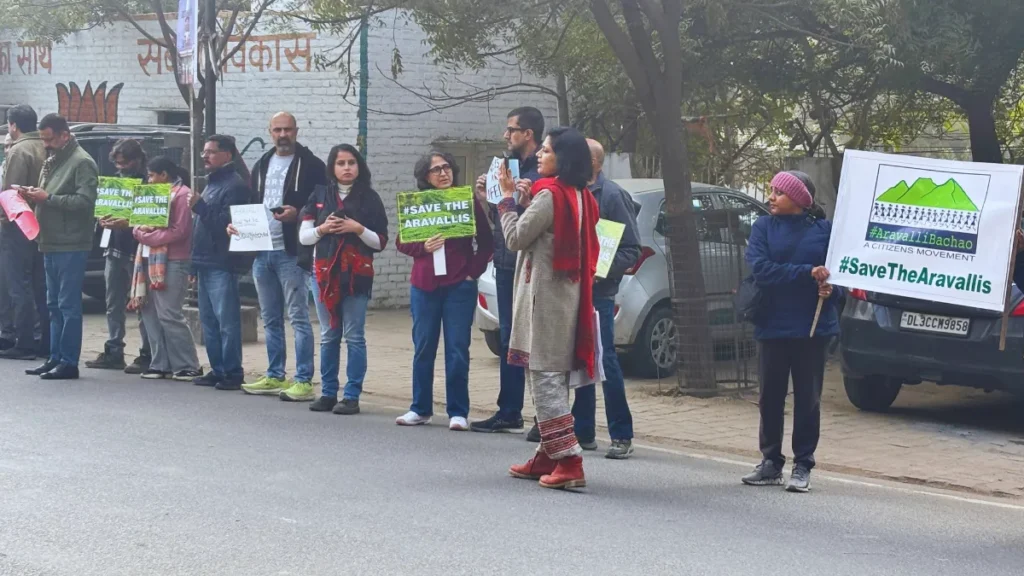
The debate around the future of the Aravalli mountain range has entered a critical phase, with Aravalli protests gaining momentum across north-west India after a recent Supreme Court ruling fundamentally altered how the ancient hills are defined. Environmentalists, scientists, citizen groups and public health experts are warning that the decision could unleash irreversible ecological damage, threatening water security, air quality, biodiversity and even food systems across large parts of India.
At the heart of the controversy lies a new, uniform definition of the Aravalli Hills, accepted by the Supreme Court in a judgement delivered on November 20, 2025. While the ruling was intended to bring clarity to long-standing disputes over land use and mining regulations, critics argue that it effectively strips protection from more than 90 per cent of the Aravalli landscape, opening vast areas to mining and commercial exploitation.
The Aravallis, stretching roughly 692 kilometres across Gujarat, Rajasthan, Haryana and Delhi, are widely regarded as India’s oldest mountain range, dating back nearly two billion years. Far more than a geological feature, they function as a natural shield against desertification, a lifeline for groundwater recharge, a pollution sink for Delhi-NCR, and a vital wildlife corridor. Protesters say redefining them by elevation alone ignores this ecological reality.
What the Supreme Court Decided
In its judgement, a Supreme Court bench accepted recommendations put forward by a committee led by the Union Ministry of Environment, Forest and Climate Change (MoEFCC). The ruling introduced a precise elevation-based definition of the Aravallis.
Under this framework, “Aravalli Hills” are defined as landforms located in officially designated Aravalli districts that rise at least 100 metres above the local relief. The definition includes the hill itself, its supporting slopes and related landforms within the lowest contour line. Additionally, two or more such hills situated within 500 metres of each other are classified collectively as the “Aravalli Range.”
On paper, the definition appears technical and neutral. On the ground, however, environmental groups argue it is deeply problematic. Large sections of the Aravallis consist of low-lying hills, scrub forests, grasslands and rocky ridges that fall below the 100-metre threshold. These areas, despite being ecologically vital, now risk being excluded from legal protection.

Why Environmentalists Call the Decision “Catastrophic”
The backlash was swift. According to conservationists involved in Aravalli protests, the new definition effectively dismantles three decades of environmental safeguards.
Since the early 1990s, multiple policies have recognised the ecological importance of the Aravallis. The 1992 Aravalli Notification issued by the MoEFCC placed restrictions on mining and industrial activity. More recently, in 2021, the National Capital Region (NCR) Planning Board declared large parts of the Aravallis as Natural Conservation Zones to protect Delhi-NCR’s fragile environment.
Critics say the Supreme Court’s acceptance of the MoEFCC-backed definition undermines these protections by focusing narrowly on elevation rather than ecological function. As a result, vast areas that were previously shielded from mining could now legally be opened for extraction.
“This is not just a legal change; it is an ecological rollback,” say members of citizen-led conservation networks. “It legitimises the destruction of landscapes that act as north-west India’s last line of defence against desertification.”
A Landscape Already Scarred by Mining
The fears driving the current wave of Aravalli protests are not hypothetical. They are grounded in decades of documented damage caused by both licensed and illegal mining across the range.
In Haryana, districts such as Charkhi Dadri and Bhiwani have already witnessed near-total devastation of their Aravalli hills due to authorised mining operations. According to The State of the Haryana Aravallis: Citizens’ Report – Part 1, submitted in May 2025 by the People for Aravallis collective, much of the region’s ancient ecological heritage has been wiped out.
In Gurugram, Nuh and Faridabad, mining activity continued aggressively until the Supreme Court imposed a ban in 2009. Even after the ban, illegal mining has persisted, often operating openly and with little fear of enforcement.
The situation in Mahendergarh district is particularly dire. Here, excessive mining—both legal and illegal—has coincided with groundwater levels plunging to 1,500–2,000 feet in several areas. Locals report dried-up wells, collapsing livelihoods and a growing dependence on water tankers.
Across Rajasthan and Gujarat, similar patterns emerge: hills flattened, forests cleared, and stone-crushing units coating entire villages in fine dust.
Desertification: A Growing and Underestimated Threat
One of the gravest concerns raised by environmental experts is the accelerating march of desertification. The Aravallis historically act as a natural barrier against the Thar Desert, slowing the movement of sand and dust eastwards.
Over the past few decades, extensive mining has already breached this barrier in multiple locations. Experts estimate that more than a dozen gaps have opened up along the Aravalli range, from Ajmer to Jhunjhunu in Rajasthan and into Mahendergarh in southern Haryana. These breaches allow dust-laden winds from the Thar to flow unhindered into Delhi-NCR, worsening air pollution and reducing soil fertility.
With the new definition enabling further mining, environmentalists fear the loss of continuity in the Aravalli range will accelerate. This could allow desert conditions to spread deeper into eastern Rajasthan, western Uttar Pradesh, Haryana and Delhi, threatening agriculture and food security for millions.
Government data already paints a worrying picture. By 2018–19, over 3,60,000 hectares—around 8.2 per cent of Haryana’s total land area—had been classified as degraded. Mining in the Aravallis is widely cited as a key driver of this degradation.
Forest Cover at Risk
Haryana’s forest cover is among the lowest in India, standing at just 3.6 per cent of the state’s land area. A significant portion of this forest lies within low-elevation hill systems of the Aravallis—precisely the areas now excluded under the 100-metre rule.
Environmentalists warn that opening these lands to mining could further shrink forest cover, pushing the state into deeper ecological crisis. Forests in the Aravallis play a critical role in enhancing rainfall, preventing drought, and moderating local climate across Gujarat, Rajasthan, Haryana and Delhi.
Tree canopies help retain atmospheric moisture, reduce wind speed and regulate temperature. For Delhi-NCR, the Aravalli forests act as “green lungs”, trapping pollutants, lowering heat intensity and contributing to climate resilience in one of the world’s most polluted urban regions.
A Threat to Water Security
Beyond forests, the Aravallis are indispensable for groundwater recharge. Their weathered rocks, riddled with natural fractures, allow rainwater to percolate deep into the earth, replenishing aquifers.
Studies estimate that the Aravalli landscape has the potential to recharge up to two million litres of groundwater per hectare. This function is vital in a region where rainfall is erratic and water demand is rising rapidly due to urbanisation and agriculture.
However, aquifers beneath the Aravallis are interconnected. Blasting hills for mining disrupts these underground systems, altering groundwater flow and degrading water quality. In many parts of the 692-kilometre belt, water tables have already fallen to alarming depths of 1,000–2,000 feet.
With more hills likely to be mined under the new definition, experts fear groundwater levels will drop even further. Surface water bodies—ponds, johads and seasonal streams—could also disappear, intensifying water scarcity across north-west India.
Agriculture and Rural Livelihoods Under Pressure
The ecological damage to the Aravallis has direct consequences for agriculture. In parts of southern Haryana and Rajasthan, farmers have already seen yields decline due to water shortages and dust pollution.
Stone-crushing units release fine particulate matter that settles on crops, reducing photosynthesis and contaminating produce. At the same time, falling groundwater levels force farmers to abandon water-intensive crops or sink deeper, costlier borewells.
Environmental groups involved in Aravalli protests warn that expanded mining will compound these problems, undermining rural livelihoods and increasing migration from villages to already-stressed cities.
Biodiversity at Stake
The Aravalli range is also a biodiversity hotspot, supporting more than 200 species of birds and a range of mammals, including leopards, hyenas, jackals, grey langurs, honey badgers and jungle cats.
Remnant forests within the Aravallis serve as critical wildlife corridors, connecting fragmented habitats and allowing animals to move safely across landscapes increasingly dominated by human development.
By excluding large tracts of low-lying hills from protection, the new definition threatens to erase these habitats. Conservationists warn that shrinking forest cover will push wildlife closer to human settlements, escalating human–wildlife conflict and increasing risks to both people and animals.
Why Aravalli Protests Are Growing
The scale of potential damage has fuelled widespread Aravalli protests, with citizen groups, environmental lawyers and scientists demanding that the new definition be reconsidered.
Protesters argue that defining a mountain range solely by elevation ignores modern ecological science. They stress that ecosystem services—such as water recharge, climate regulation and pollution control—do not depend on height alone.
There is also concern that the MoEFCC’s recommendation, now upheld by the Supreme Court, prioritises administrative convenience and economic interests over environmental sustainability.
Calls for Reconsideration
Environmental advocates are urging policymakers and the judiciary to scrap the elevation-based definition and adopt a holistic, science-backed approach that recognises the full ecological footprint of the Aravalli range.
They argue that safeguarding the Aravallis is not merely an environmental issue but a matter of public health, economic stability and intergenerational justice.
“The Aravallis protect our air, our water and our food systems,” say members of civil society groups. “If we lose them, no amount of technology will bring them back.”
Read also: Tamil Nadu Launches ₹50-Crore Endangered Species Conservation Fund with a New Management Framework
An Uncertain Future
As Aravalli protests continue to gather strength, the future of India’s oldest mountain range hangs in the balance. The Supreme Court’s ruling may have sought clarity, but critics say it has instead opened the door to ecological chaos.
With desertification advancing, groundwater depleting and air pollution worsening, many fear that redefining the Aravallis could push north-west India past a tipping point.
For millions who depend—often unknowingly—on the silent services provided by these ancient hills, the outcome of this debate will shape the region’s environmental and economic future for generations to come.